Article A13 · Book 1 · Scrapbook page p.12
IT'S NOT JUST OLE MAS'



Page 6 TRINIDAD GUARDIAN, Friday, January 30, 1970
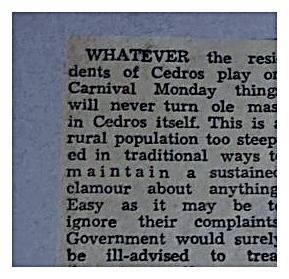
WHATEVER the residents of Cedros play on Carnival Monday things will never turn ole mas' in Cedros itself. This is a rural population too steeped in traditional ways to maintain a sustained clamour about anything. Easy as it may be to ignore their complaints, Government would surely be ill-advised to treat them so casually.
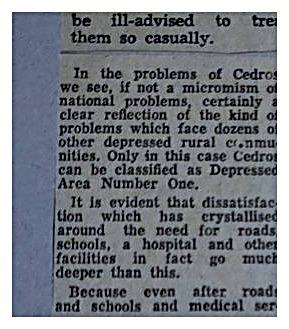
In the problems of Cedros we see, if not a micromism [sic] of national problems, certainly a clear reflection of the kind of problems which face dozens of other depressed rural communities. Only in this case Cedros can be classified as Depressed Area Number One.
It is evident that dissatisfaction which has crystallised around the need for roads, schools, a hospital and other facilities in fact go much deeper than this.
Because even after roads and schools and medical services are provided, the residents will be no closer to enjoying a better standard of living to which ultimately all will aspire.
The fact is that the dice are heavily loaded against Cedros and the majority of its 15,000 residents. Geographically it is both remote and out of everyone's way. One does not pass through Cedros to go anywhere — one simply has to go to Cedros and as yet there are no compelling reasons why people from anywhere else in Trinidad would want to go down there.
Then the pattern of economic activity in the area has offered scope for a minimum of enterprise and initiative from the mass of the population. The large plantations have only needed labourers and few fishermen have got to the stage where they can afford boats and gear.
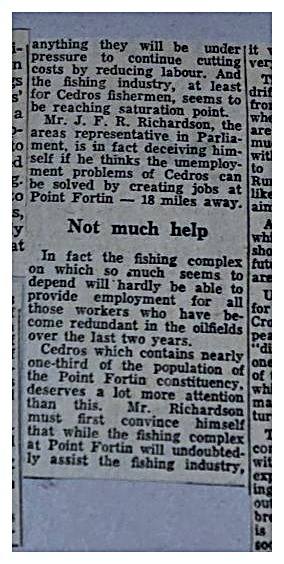
The coconut plantations themselves will not be able to absorb any more people — if anything they will be under pressure to continue cutting costs by reducing labour. And the fishing industry, at least for Cedros fishermen, seems to be reaching saturation point.
Mr. J. P. R. Richardson, the areas representative in Parliament, is in fact deceiving himself if he thinks the unemployment problems of Cedros can be solved by creating jobs at Point Fortin — 18 miles away.
Not much help
In fact the fishing complex on which so much seems to depend will hardly be able to provide employment for all those workers who have become redundant in the oilfields over the last two years.
Cedros which contains nearly one-third of the population of the Point Fortin constituency, deserves a lot more attention than this. Mr. Richardson must first convince himself that while the fishing complex at Point Fortin will undoubtedly assist the fishing industry, it will not really help Cedros very much.
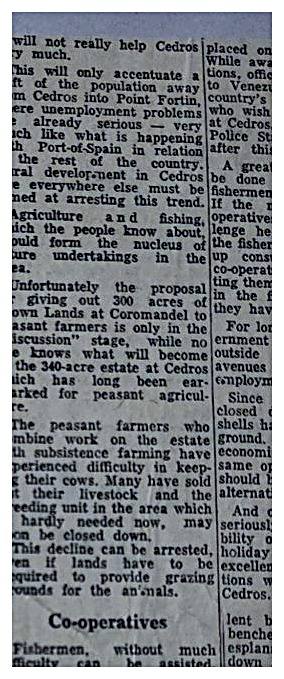
This will only accentuate a drift of the population away from Cedros into Point Fortin, where unemployment problems are already serious — very much like what is happening with Port-of-Spain in relation to the rest of the country. Rural development in Cedros like everywhere else must be aimed at arresting this trend.
Agriculture and fishing, which the people know about, should form the nucleus of future undertakings in the area.
Unfortunately the proposal for giving out 300 acres of Crown Lands at Coromandel to peasant farmers is only in the "discussion" stage, while no one knows what will become of the 340-acre estate at Cedros which has long been ear-marked for peasant agriculture.
The peasant farmers who combine work on the estate with subsistence farming have experienced difficulty in keeping their cows. Many have sold out their livestock and the breeding unit in the area which is hardly needed now, may soon be closed down.
This decline can be arrested, even if lands have to be acquired to provide grazing grounds for the animals.
Co-operatives
Fishermen, without much difficulty can be assisted. Naturally most of the shrimp trawlers will want to make use of the facilities that are promised at the Shell complex. But this can be no reason for writing off Cedros itself.
Hundreds of fishermen at Cedros are going to need those very basic beach facilities which have been promised time and again by politicians visiting Bonasse.
For the present the shrimping business at Cedros can be placed on a firmer footing. While awaiting formal negotiations, official nod can be given to Venezuelans satisfying the country's health requirements who wish to sell their shrimp at Cedros. No doubt the Cedros Police Station itself can look after this.
A great deal more can also be done for the hundreds of fishermen on the Cedros beach. If the new Minister of Co-operatives accepts the challenge he can certainly assist the fishermen by helping to set up consumer and marketing co-operatives — in effect getting them more deeply involved in the fishing industry than they have so far been.
For long-term prospects Government will have to move outside these traditional avenues which have provided employment in the area.
Since the fibre factory was closed down, tons of coconut shells have been rotting on the ground. Even if it is uneconomical to re-start the same operation, the IDC itself should be able to come up with alternative suggestions.
And outside of this one can seriously examine the possibility of developing a small holiday resort, in view of the excellent environmental conditions which can be found at Cedros. The beaches are excellent but neglected, even the benches on the beautiful esplanade at Cedros are broken down and unpainted.
Also unique are the attractions of the wildlife in the area. Those who know about twinning cities will find that Cedros can be very easily linked up with any of the cities of Eastern Venezuela, and this could provide the basis for a legitimate low-budget tourist traffic across the Gulf.
Trinidadians themselves would be happy to get away from Mayaro for a change, if suitable resort accommodation were available even at Icacos.
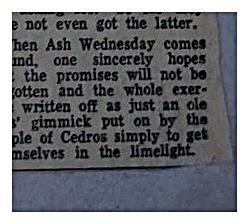
While this may all sound like wishful thinking, it is certainly not outside the scope of practical achievement. But this requires a vision beyond the health services and immediate facilities the residents are asking for. So far they have not even got the latter.
When Ash Wednesday comes around, one sincerely hopes that the promises will not be forgotten and the whole exercise written off as just an ole mas' gimmick put on by the people of Cedros simply to get themselves in the limelight.
Conclusion... by NIZAM ALI