Article A25 · Book 1 · Scrapbook page p.21
You will never meet another man like Michael Pascall
Page 10 EXPRESS Tuesday, August 17, 1971
IN THE LONELY SOUTH-WESTERN
YOU'LL never meet another Michael Pascall — especially if you're looking for a Roman Catholic Priest.
"This is a great day for me", he said, when he saw us during the weekend. "I always wanted to get to know the man who has done so much for cycling in Trinidad. I recognised you right away."
He was talking to A.N. 'Zobln' [as printed; possibly 'Zobin'] Alexander, the forgotten track star and promoter who, in his sixties, works for the EXPRESS as a photographer. And it was plain to all of us that the difference between Fr. Pascall saying this and anybody else is that he means it.
He is not afraid to do what he thinks he should — even though it sometimes gets him at odds with the establishment. Who else could have organised and played mas' with the protest band from Cedros that was a hit in Port-of-Spain?
"I had to raise $2,000 and get mas' men to come down here and help us with the planning. Of course, many people could not accept the idea of a Catholic priest leaving his parish to jump up in Port-of-Spain. But we had to get our message across, we had to let people know through the news media that the people up here are catching their 'nennen.' "And it worked."
Zest for life
He doesn't look 41. There is an exuberance and zest for life that, for him, will be ageless. He talks a lot, laughs a great deal — even at the setbacks that would have sent some lesser mortal well on the road to St. Ann's. He is no saint, in fact one gets the impression that he does not really believe in many saints, does not accept the ancient dogmas and trappings of his religion.
There are lots of candles in the drawing room of the house at the back of the Cedros Roman Catholic Church, but they are functional, not decorative or for use as visual aides to heaven. [as printed]
"We have do-it-yourself electricity here," Fr. Pascall explains with a laugh. "You can't tell when the supply will fail."
I had taken two fellows along for the ride, and just after we began talking he noticed them sitting a little self-consciously in the car.
"Bring them in. Bring them in" he said, and before I could move he was on his way, waving them inside to the porch that was full of uneasy chairs which must have seen better days about 15 years ago.
Short pants
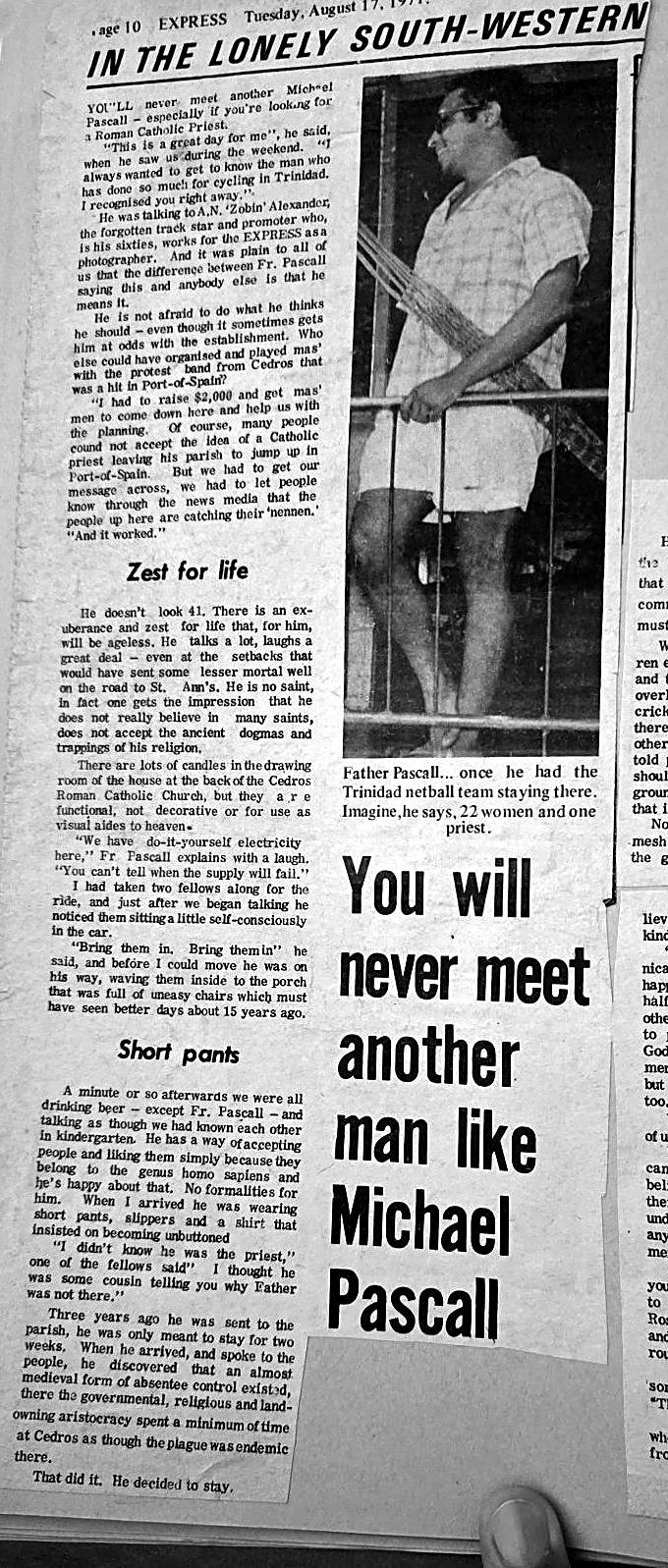
A minute or so afterwards we were all drinking beer — except Fr. Pascall — and talking as though we had known each other in kindergarten. He has a way of accepting people and liking them simply because they belong to the genus homo sapiens and he's happy about that. No formalities for him. When I arrived he was wearing short pants, slippers and a shirt that insisted on becoming unbuttoned.
"I didn't know he was the priest," one of the fellows said" I thought he was some cousin telling you why Father was not there."
Three years ago he was sent to the parish, he was only meant to stay for two weeks. When he arrived, and spoke to the people, he discovered that an almost medieval form of absentee control existed, there the governmental, religious and landowning aristocracy spent a minimum of time at Cedros as though the plague was endemic there.
That did it. He decided to stay.
[Photo: Father Pascall… once he had the Trinidad netball team staying there. Imagine, he says, 22 women and one priest.]
[Piece 2 of 3 — "Informal" continuation piece]
Informal
He takes things in his stride. From the apparent failure of the co-operative that he knows is desperately needed in the community, to the little problems that must be met from day to day.
While we were there, a few children entered the yard to play. He laughed and told us that we were at the pavilion overlooking the unofficial minor league cricket field — "pass out" was played there. Faced with that sort of racket, other clergymen may have discreetly told parents after Mass that their kids should be encouraged to find another ground somewhere in the vast expanse that is Cedros.
Not, Fr. Pascall. He placed wire-mesh over his glass louvres and enjoys the game as much as they do. He be—
[Piece 3 of 3 — lower continuation piece]
—lieves in an informal, down to earth kind of Christianity.
"People tend to formalise communication with God," he says. "But what happens? You go to church and find half of the congregation not talking to the other half. They have gone to church to pray. I believe that a man serves God best by his dealings with other men — not just his immediate circle, but the people he meets along the way too."
We talked for a long time, the five of us. He spoke of his stay in Africa.
During his nine years there he came to know and love the people and believes that the method of worship there, where families pray together under a tree or in their homes or anywhere they feel to, is to be commended.
When we were leaving he said: "Well, you can't go on one foot." And he called to the housekeeper, whose name was Rose I think, and who is a very friendly and easy going type, to bring another round.
"Oh Lawd, Father," Rose yelled from somewhere in the depths of the house, "The beers hot."
That was no problem to Fr. Pascall who led us to a bar that was converted from an old altar.