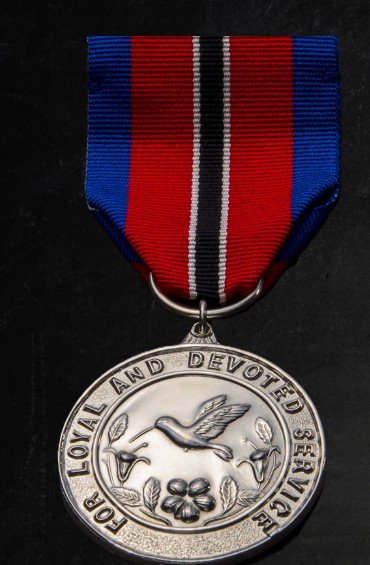
Article A30 · Book 1 · Scrapbook page pp.27–28
P-s-s-s-t... You Want A National Award?
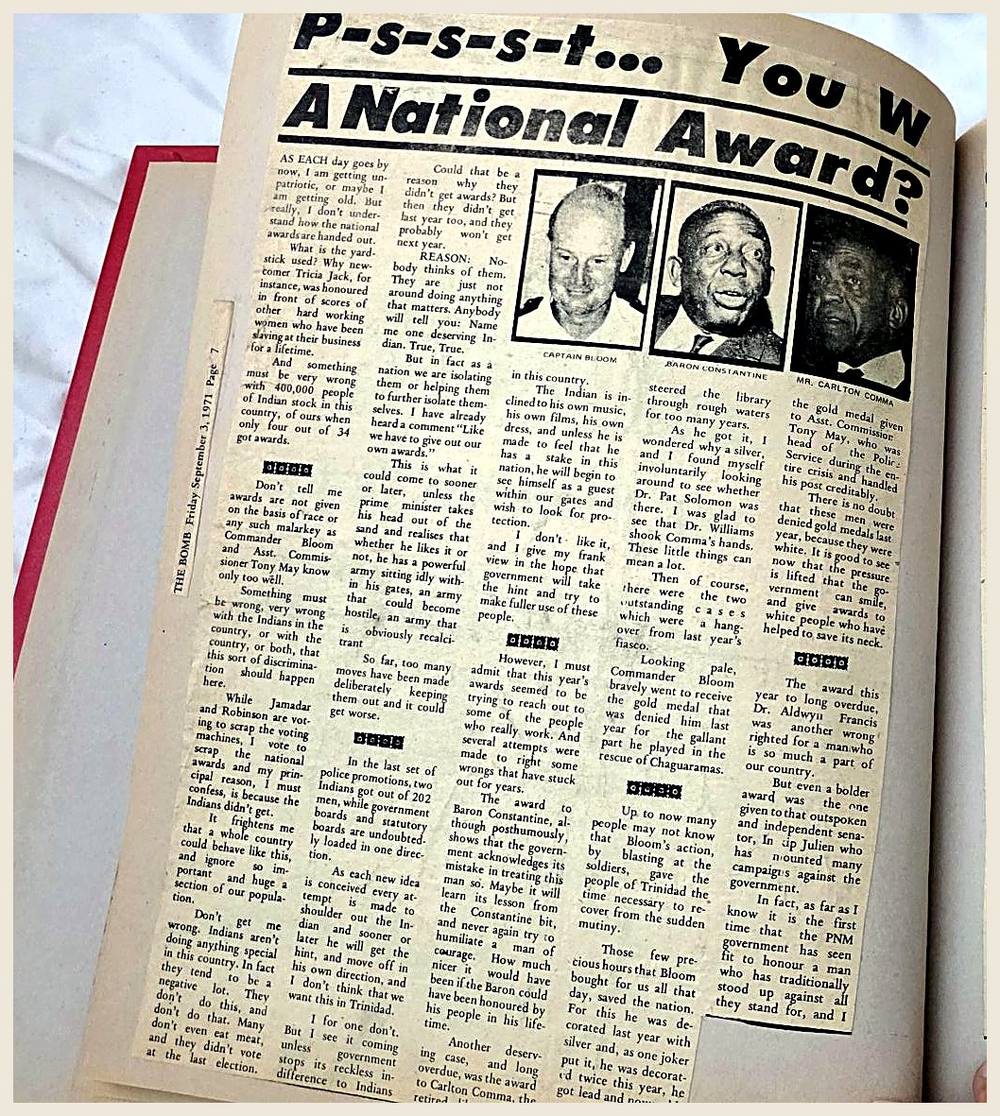
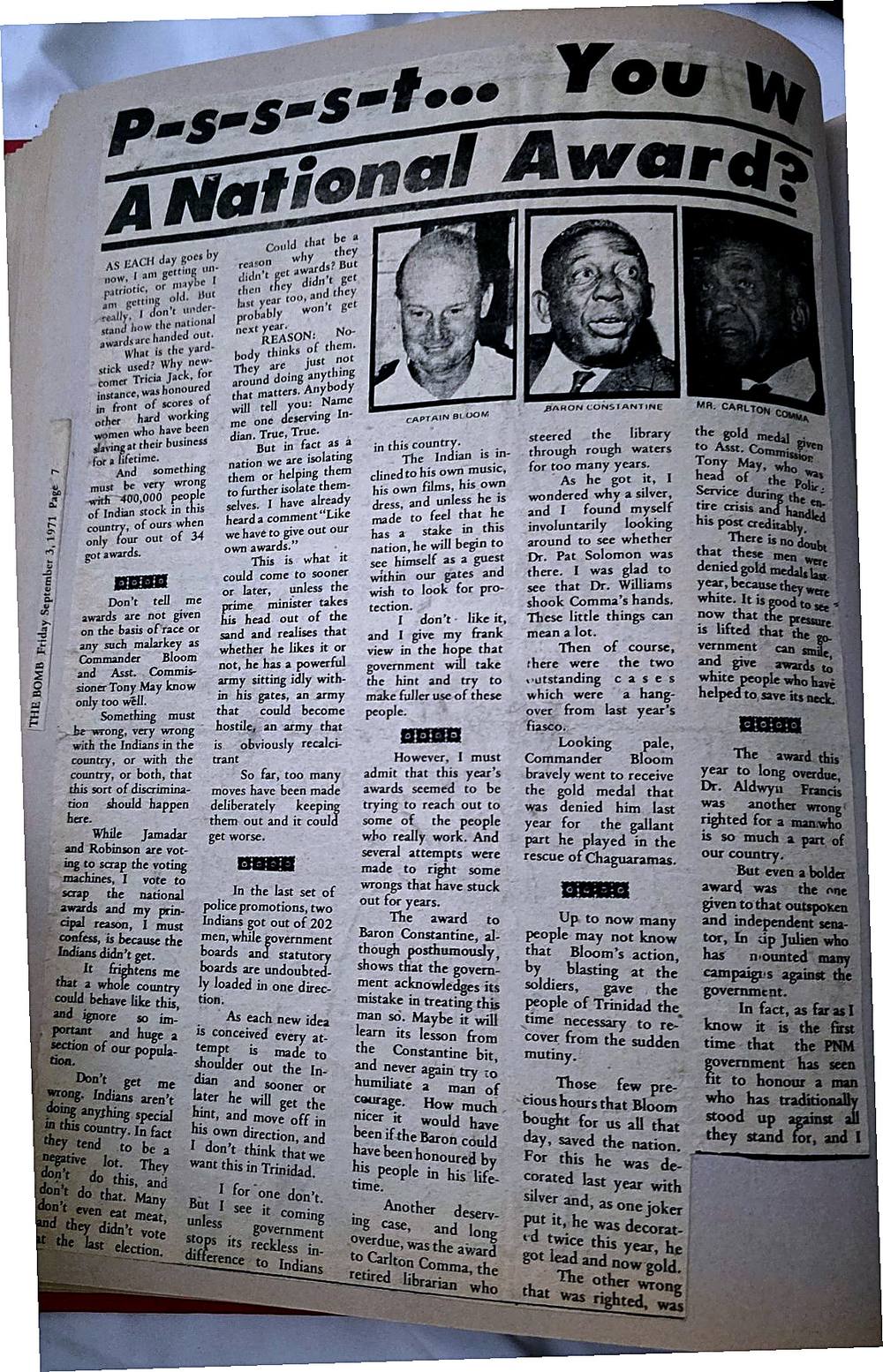
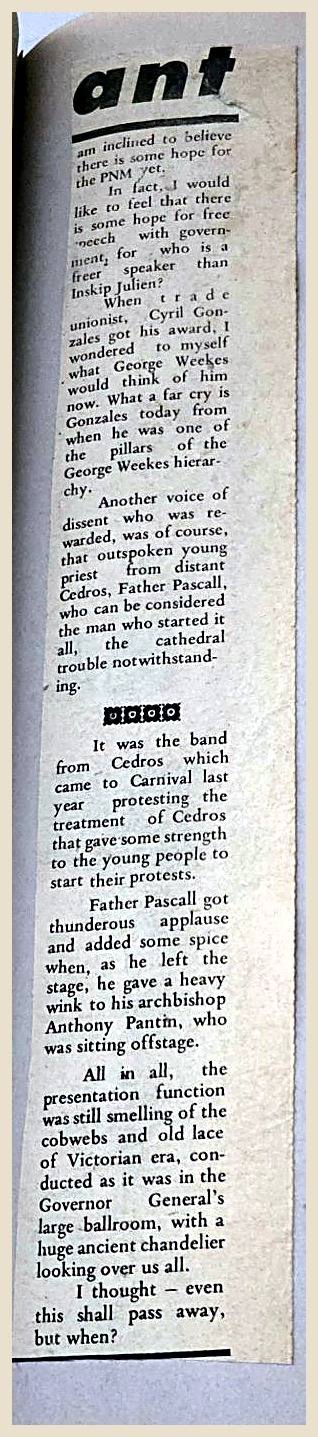
[The headline's last word is completed by the fragment "ant" standing at the head of the continuation piece on p.28 — "W" closes the p.27 page, "ant" opens the p.28 piece.]
[First column]
AS EACH day goes by now, I am getting unpatriotic, or maybe I am getting old. But really, I don't understand how the national awards are handed out.
What is the yardstick used? Why newcomer Tricia Jack, for instance, was honoured in front of scores of other hard working women who have been slaving at their business for a lifetime.
And something must be very wrong with 400,000 people of Indian stock in this country, of ours when only four out of 34 got awards.
*
Don't tell me awards are not given on the basis of race or any such malarkey as Commander Bloom and Asst. Commissioner Tony May know only too well.
Something must be wrong, very wrong with the Indians in the country, or with the country, or both, that this sort of discrimination should happen here.
While Jamadar and Robinson are voting to scrap the voting machines, I vote to scrap the national awards and my principal reason, I must confess, is because the Indians didn't get.
It frightens me that a whole country could behave like this, and ignore so important and huge a section of our population.
Don't get me wrong. Indians aren't doing anything special in this country. In fact they tend to be a negative lot. They don't do this, and don't do that. Many don't even eat meat, and they didn't vote at the last election.
[Second column]
Could that be a reason why they didn't get awards? But then they didn't get last year too, and they probably won't get next year.
REASON: Nobody thinks of them. They are just not around doing anything that matters. Anybody will tell you: Name me one deserving Indian. True, True.
But in fact as a nation we are isolating them or helping them to further isolate themselves. I have already heard a comment "Like we have to give out our own awards."
This is what it could come to sooner or later, unless the prime minister takes his head out of the sand and realises that whether he likes it or not, he has a powerful army sitting idly within his gates, an army that could become hostile, an army that is obviously recalcitrant.
So far, too many moves have been made deliberately keeping them out and it could get worse.
*
In the last set of police promotions, two Indians got out of 202 men, while government boards and statutory boards are undoubtedly loaded in one direction.
As each new idea is conceived every attempt is made to shoulder out the Indian and sooner or later he will get the hint, and move off in his own direction, and I don't think that we want this in Trinidad.
I for one don't. But I see it coming unless government stops its reckless indifference to Indians
[Third column — below the photograph of Captain Bloom]
in this country.
The Indian is inclined to his own music, his own films, his own dress, and unless he is made to feel that he has a stake in this nation, he will begin to see himself as a guest within our gates and wish to look for protection.
I don't like it, and I give my frank view in the hope that government will take the hint and try to make fuller use of these people.
*
However, I must admit that this year's awards seemed to be trying to reach out to some of the people who really work. And several attempts were made to right some wrongs that have stuck out for years.
The award to Baron Constantine, although posthumously, shows that the government acknowledges its mistake in treating this man so. Maybe it will learn its lesson from the Constantine bit, and never again try to humiliate a man of courage. How much nicer it would have been if the Baron could have been honoured by his people in his lifetime.
Another deserving case, and long overdue, was the award to Carlton Comma, the retired librarian who
[Photographs across the top of the page, with captions: CAPTAIN BLOOM; BARON CONSTANTINE; MR. CARLTON COMMA — all three photographs and captions are fully in frame in the reshoot.]
[Fourth column — below the photograph of Baron Constantine]
steered the library through rough waters for too many years.
As he got it, I wondered why a silver, and I found myself involuntarily looking around to see whether Dr. Pat Solomon was there. I was glad to see that Dr. Williams shook Comma's hands. These little things can mean a lot.
Then of course, there were the two outstanding cases which were a hangover from last year's fiasco.
*
Looking pale, Commander Bloom bravely went to receive the gold medal that was denied him last year for the gallant part he played in the rescue of Chaguaramas.
*
Up to now many people may not know that Bloom's action, by blasting at the soldiers, gave the people of Trinidad the time necessary to recover from the sudden mutiny.
Those few precious hours that Bloom bought for us all that day, saved the nation. For this he was decorated last year with silver and, as one joker put it, he was decorated twice this year, he got lead and now gold.
The other wrong that was righted, was
[Fifth column — the right-hand column, complete in the reshoot]
the gold medal given to Asst. Commissioner Tony May, who was head of the Police Service during the entire crisis and handled his post creditably.
There is no doubt that these men were denied gold medals last year, because they were white. It is good to see now that the pressure is lifted that the government can smile, and give awards to white people who have helped to save its neck.
*
The award this year to long overdue, Dr. Aldwyn Francis was another wrong righted for a man who is so much a part of our country.
But even a bolder award was the one given to that outspoken and independent senator, Inskip Julien who has mounted many campaigns against the government.
In fact, as far as I know it is the first time that the PNM government has seen fit to honour a man who has traditionally stood up against all they stand for, and I
[The p.27 piece ends here, mid-sentence; the column continues on the piece glued at the left of scrapbook p.28 — see below.]
[Continuation — scrapbook p.28 piece; the piece begins mid-word, with the headline fragment "ant" at its head]
[begins mid-sentence] ...am inclined to believe there is some hope for the PNM yet.
In fact, I would like to feel that there is some hope for free speech with government, for who is a freer speaker than Inskip Julien?
When trade unionist, Cyril Gonzales got his award, I wondered to myself what George Weekes would think of him now. What a far cry is Gonzales today from when he was one of the pillars of the George Weekes hierarchy.
Another voice of dissent who was rewarded, was of course, that outspoken young priest from distant Cedros, Father Pascall, who can be considered the man who started it all, the cathedral trouble notwithstanding.
[ornamental divider]
It was the band from Cedros which came to Carnival last year protesting the treatment of Cedros that gave some strength to the young people to start their protests.
Father Pascall got thunderous applause and added some spice when, as he left the stage, he gave a heavy wink to his archbishop Anthony Pantin, who was sitting offstage.
All in all, the presentation function was still smelling of the cobwebs and old lace of Victorian era, conducted as it was in the Governor General's large ballroom, with a huge ancient chandelier looking over us all.
I thought — even this shall pass away, but when?