Article A50 · Book 1 · Loose insert
'The Catholic who is not a revolutionary is living in mortal sin'
BY OWEN BAPTISTE
I HAVE been told by friends that a high court judge, in a living-room conversation recently, stated that "in the revolution, St. Mary's College should be the first to go." My immediate response was that the judge was talking nonsense, that he was wrong and that his bombs or reforms should be directed instead at the Ministry of Education.
Now, however, I am not so sure. I believe, in fact, that my quick defence of St. Mary's College sprang firstly from my school loyalties and secondly from my conviction that the Ministry of Education has been the source of most of our schools' — and the society's — problems.
I believe also that as I was not a party to the original conversation it is possible that the judge was not concerned with St. Mary's academic success — what we have been accustomed to think of first — but with its failure to involve itself in the attempt to change our cultural hegemony and to develop a new specimen of Trinidadian.
As an ex-student of St. Mary's, I cannot defend with a clear conscience the Holy Ghost Fathers against such an accusation. I spent four years there — true, long before Trinidad and Tobago became independent — but I was never aware that we were taught anything more fundamental than gaining examination passes.
I must admit, therefore, that St. Mary's deserves to be misunderstood and that the priestly hierarchy there are guilty of some kind of sin of omission. But even this is an euphemism: Fr. Camilo Torres, before he was shot dead in the hills of Colombia, stated that "the Catholic who is not a revolutionary is living in mortal sin." In his own words, he "took off his cassock to be more truly a priest."
I am not unaware, of course, that the pedantic and popular thing today is to malign the Church, to ask rhetorically and with malice what it has done for us? What it has done (in the West Indies) for poor blacks? This is not simply the outcome of last year's "revolution" and the "invasion" of the Roman Catholic Cathedral, though what happened last year has given much courage or conviction to the question.
But the doubt, the accusation or the absurdity has much wider meaning, much deeper resentment. The truth is, the Church [in] Trinidad and Tobago has traditionally appeared to be so aligned with the so-called power structure that its interests can be negatively interpreted as opposed to the masses and antagonistic to any movement to change the system.
"The Church," Rev. Idris Hamid wrote recently, "is so alienated from these people (the growing number of disadvantaged) [that] some would question whether it can really minister to them." And the reason for this, Rev. Hamid sees, is the fact that colonialisation took place on, at least, four levels — political, economic, cultural and religious and, unfortunately, "the theology of the church is the last bastion of colonialism" and "still remains a colonialising and enslaving theology."
This is a view which is supported by Fr. [column foot lost at the fold]
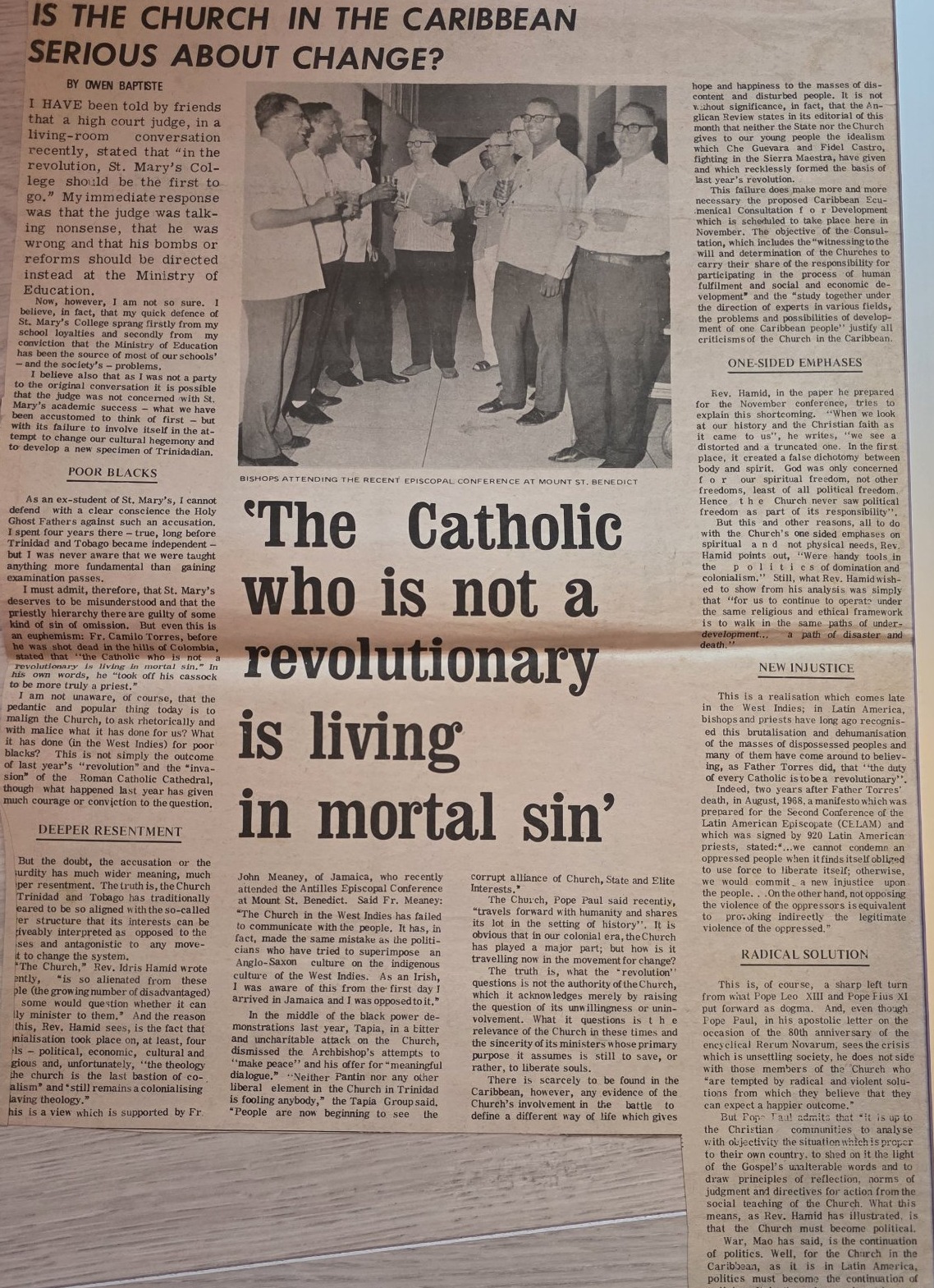
John Meaney, of Jamaica, who recently attended the Antilles Episcopal Conference at Mount St. Benedict. Said Fr. Meaney: "The Church in the West Indies has failed to communicate with the people. It has, in fact, made the same mistake as the politicians who have tried to superimpose an Anglo-Saxon culture on the indigenous culture of the West Indies. As an Irish, I was aware of this from the first day I arrived in Jamaica and I was opposed to it."
In the middle of the black power demonstrations last year, Tapia, in a bitter and uncharitable attack on the Church, dismissed the Archbishop's attempts to "make peace" and his offer for "meaningful dialogue." "Neither Pantin nor any other liberal element in the Church in Trinidad is fooling anybody," the Tapia Group said. "People are now beginning to see the corrupt alliance of Church, State and Elite Interests."
The Church, Pope Paul said recently, "travels forward with humanity and shares its lot in the setting of history." It is obvious that in our colonial era, the Church has played a major part; but how is it travelling now in the movement for change?
The truth is, what the "revolution" questions is not the authority of the Church, which it acknowledges merely by raising the question of its unwillingness or uninvolvement. What it questions is the relevance of the Church in these times and the sincerity of its ministers whose primary purpose it assumes is still to save, or rather, to liberate souls.
There is scarcely to be found in the Caribbean, however, any evidence of the Church's involvement in the battle to define a different way of life which gives hope and happiness to the masses of discontent and disturbed people. It is not without significance, in fact, that the Anglican Review states in its editorial of this month that neither the State nor the Church gives to our young people the idealism which Che Guevara and Fidel Castro, fighting in the Sierra Maestra, have given and which recklessly formed the basis of last year's revolution.
This failure does make more and more necessary the proposed Caribbean Ecumenical Consultation for Development which is scheduled to take place here in November. The objective of the Consultation, which includes the "witnessing to the will and determination of the Churches to carry their share of the responsibility for participating in the process of human fulfilment and social and economic development" and the "study together under the direction of experts in various fields, the problems and possibilities of development of one Caribbean people" justify all criticisms of the Church in the Caribbean.
Rev. Hamid, in the paper he prepared for the November conference, tries to explain this shortcoming. "When we look at our history and the Christian faith as it came to us," he writes, "we see a distorted and a truncated one. In the first place, it created a false dichotomy between body and spirit. God was only concerned for our spiritual freedom, not other freedoms, least of all political freedom. Hence the Church never saw political freedom as part of its responsibility."
But this and other reasons, all to do with the Church's one sided emphases on spiritual and not physical needs, Rev. Hamid points out, "Were handy tools in the politics of domination and colonialism." Still, what Rev. Hamid wished to show from his analysis was simply that "for us to continue to operate under the same religious and ethical framework is to walk in the same paths of underdevelopment... a path of disaster and death."
This is a realisation which comes late in the West Indies; in Latin America, bishops and priests have long ago recognised this brutalisation and dehumanisation of the masses of dispossessed peoples and many of them have come around to believing, as Father Torres did, that "the duty of every Catholic is to be a revolutionary."
Indeed, two years after Father Torres' death, in August, 1968, a manifesto which was prepared for the Second Conference of the Latin American Episcopate (CELAM) and which was signed by 920 Latin American priests, stated: "...we cannot condemn an oppressed people when it finds itself obliged to use force to liberate itself; otherwise, we would commit a new injustice upon the people... On the other hand, not opposing the violence of the oppressors is equivalent to provoking indirectly the legitimate violence of the oppressed."
This is, of course, a sharp left turn from what Pope Leo XIII and Pope Pius XI put forward as dogma. And, even though Pope Paul, in his apostolic letter on the occasion of the 80th anniversary of the encyclical Rerum Novarum, sees the crisis which is unsettling society, he does not side with those members of the Church who "are tempted by radical and violent solutions from which they believe that they can expect a happier outcome."
But Pope Paul admits that "it is up to the Christian communities to analyse with objectivity the situation which is proper to their own country, to shed on it the light of the Gospel's unalterable words and to draw principles of reflection, norms of judgment and directives for action from the social teaching of the Church. What this means, as Rev. Hamid has illustrated, is that the Church must become political.
War, Mao has said, is the continuation of politics. Well, for the Church in the Caribbean, as it is in Latin America, politics must become the continuation of religion. It is the only way it can become of the people. It is the only way it will survive.
● TO BE CONTINUED NEXT SUNDAY