Article A51 · Book 1 · Loose insert
Church must produce a new society

● From Page 8
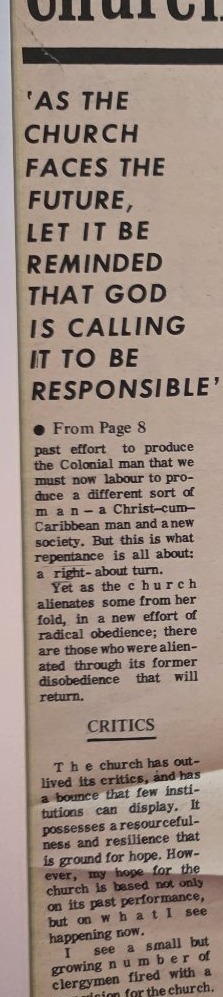
[past] effort to produce the Colonial man that we must now labour to produce a different sort of man — a Christ-cum-Caribbean man and a new society. But this is what repentance is all about: a right-about turn.
Yet as the church alienates some from her fold, in a new effort of radical obedience; there are those who were alienated through its former disobedience that will return.
The church has outlived its critics, and has a bounce that few institutions can display. It possesses a resourcefulness and resilience that is ground for hope. However, my hope for the church is based not only on its past performance, but on what I see happening now.
I see a small but growing number of clergymen fired with a new vision for the church. And this is not just the "concerned clergy" group. Their experimentations and identification with the underprivileged are refreshing.
Fr. Pascal at Cedros, Fr. Bennet at Mayaro, and Fr. Knolly Clarke at Princes Town are cases in point. There is also a new awareness among the majority of ministerial students that is going to produce a new breed of pastors and priests.
Then there are lay groups such as those that participated in a project like Christ's College in Princes Town. The experiments in Liturgy at St. John Vianney Seminary and the encounter workshops for young people by Rev. Jeff Elder all augurs well for the future.
These glimmers of hope — for they are only this — must not be construed to read that the problems are solved. The challenge of fundamental changes in structure, emphasis and style of church life is yet to be faced. If these are not handled promptly and tactfully there may arise alienations, and loss of progressive leadership.
If I may venture a suggestion in this new milieu, I would plug for the way of pluri-formity. The church in the middle ages despite its image of rigidity had a remarkable flexibility — enough to accommodate a hippie-like St. Francis.
Different religious orders were allowed to emerge and function, doing their own thing, yet within the church. This flexibility and freedom should be encouraged to individuals and groups, both lay and clerical, across denominational lines.
This pluri-formity lends itself to wide experimentation and would cater to different groups with wide ranging interest. In this way new patterns of obedience and life-styles may emerge.
As the church faces the future, let it be reminded that there is a future to which God is calling it to be responsible. And only as it responds to God's future faithfully will it know the joy of work well done.